
Home › Guides › Filling marina berths in 2026
UK marinas in 2026: how to fill berths as enquiries soften
By Justin Allitt · 21 November 2026 · For marina owners and managers
Most UK marinas still run close to full. Yet British Marine’s latest market report shows operators growing more cautious, with fewer enquiries and an older customer base. If you run a marina, the next empty berth may take longer to fill than the last one.
What the market looks like
- Stable but softening. British Marine’s UK Marina & Moorings Market Report 2025, published in January 2026, found occupancy still high across much of the UK, but half of operators expect their local market to weaken.
- Fewer enquiries. Operators named falling enquiries, affordability for an ageing customer base, and more competition as their main worries.
- Size and setting matter. Larger operators are doing better than sites with under 100 berths, and coastal marinas slightly better than inland ones.
- Residential holds up. Residential berths and boatyard services have stayed more resilient than leisure berths.
The figures behind it
| Measure | Figure | What it means for marinas |
|---|---|---|
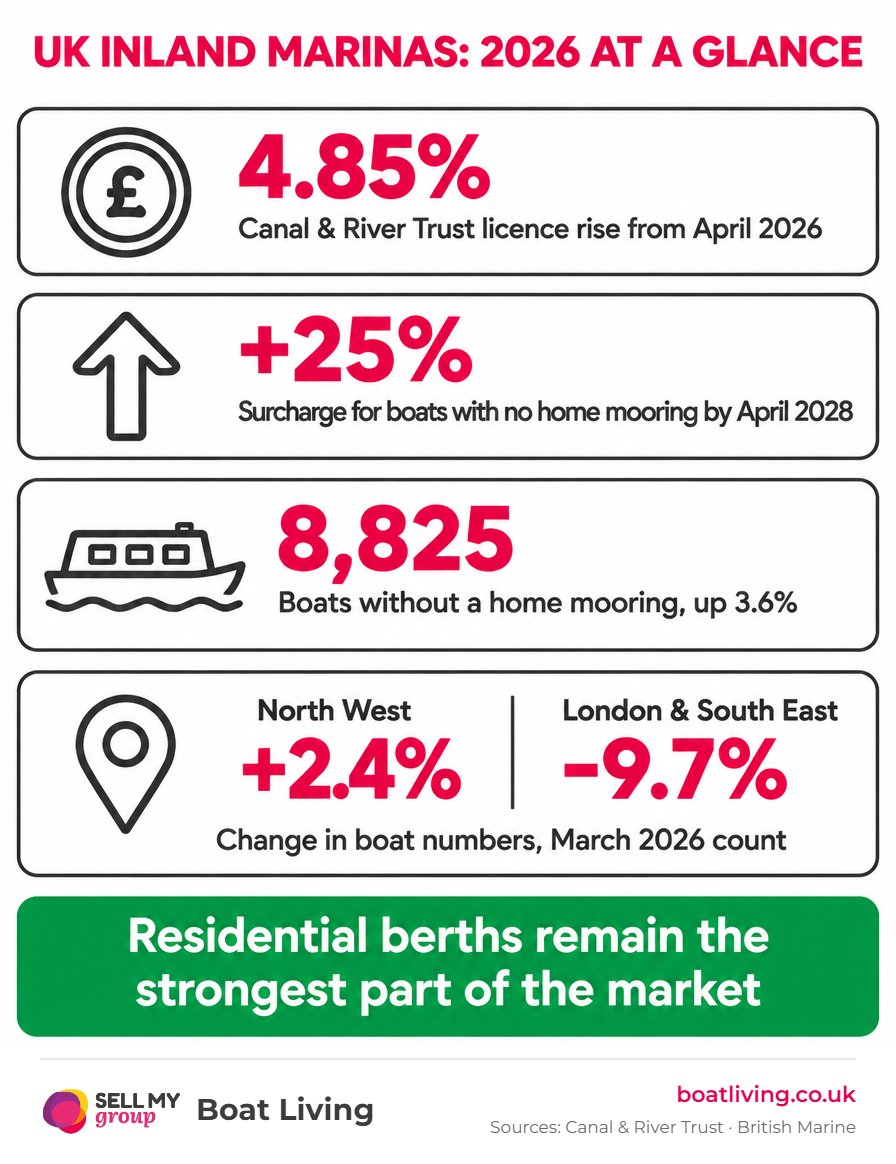
| Canal & River Trust licence rise, April 2026 | 4.85% | Boating costs keep rising for every owner |
| Surcharge for boats with no home mooring | 15% now, 25% by April 2028 | A home berth gets better value every year |
| Boats without a home mooring, March 2026 | 8,825 (up 3.6%) | A growing pool of boaters you could win |
| Boats on Trust waterways, March 2026 | 32,376 (down 2.1%) | Fewer boats overall, so competition for each one |
| North West boat numbers | Up 2.4% | Growing demand in the North West |
| London and South East boat numbers | Down 9.7% | Softer demand in the South East |
Sources: Canal & River Trust boat licence fees 2026-27 and National Boat Count 2026; British Marine UK Marina & Moorings Market Report 2025.
Five ways to fill berths in 2026
- Sell the home mooring against the surcharge. A continuous cruiser now pays a surcharge on top of the standard licence, and it rises each April to 25% by 2028. Put that figure next to your berth price and show the gap closing.
- Look at residential. Residential berths are the part of the market with waiting lists. Mercia Marina in Derbyshire had a waiting list of around 90 berth holders wanting to upgrade, and in 2021 won permission for 100 more residential moorings. Permanent residential moorings need planning permission, and council tax needs settling, so speak to your local planning authority early. Our guide to residential and leisure moorings explains the difference to your customers.
- List the boats already on your pontoons. A boat sold with its berth keeps the berth full, and many marinas earn a transfer fee on the sale. See buying a boat with a mooring. Buyers search for boats first and moorings second.
- Answer enquiries the same day. When enquiries fall, every one counts. A buyer who waits until Thursday has often found somewhere else by then.
- Be easy to find online. Show your berth prices, residential status, facilities and contact details where boaters search. A marina with no phone number or email on its listing loses the enquiry.
“We spent over ten years building Sell My Group into the UK’s largest park home and holiday home portal, and the lesson carries straight over to marinas. Buyers start online, and the sites that show up there get the enquiries. Every empty berth costs a marina money each month, so we’ve made Boat Living free to list. Marinas can put their berths and the boats on their pontoons in front of people who are looking right now.”
Justin Allitt, founder, Boat Living and Sell My Group
List your marina and boats free
Boat Living is free for marinas, brokers and private sellers. There’s no fee and no commission, and enquiries come straight to you. Claim your marina page to add your berth prices and contact details, or list the boats for sale on your pontoons.